My Cinema World
- 4.6
- Rating
- 5.00M
- Installs
- Free
- Price

 Analysis by App-foxy
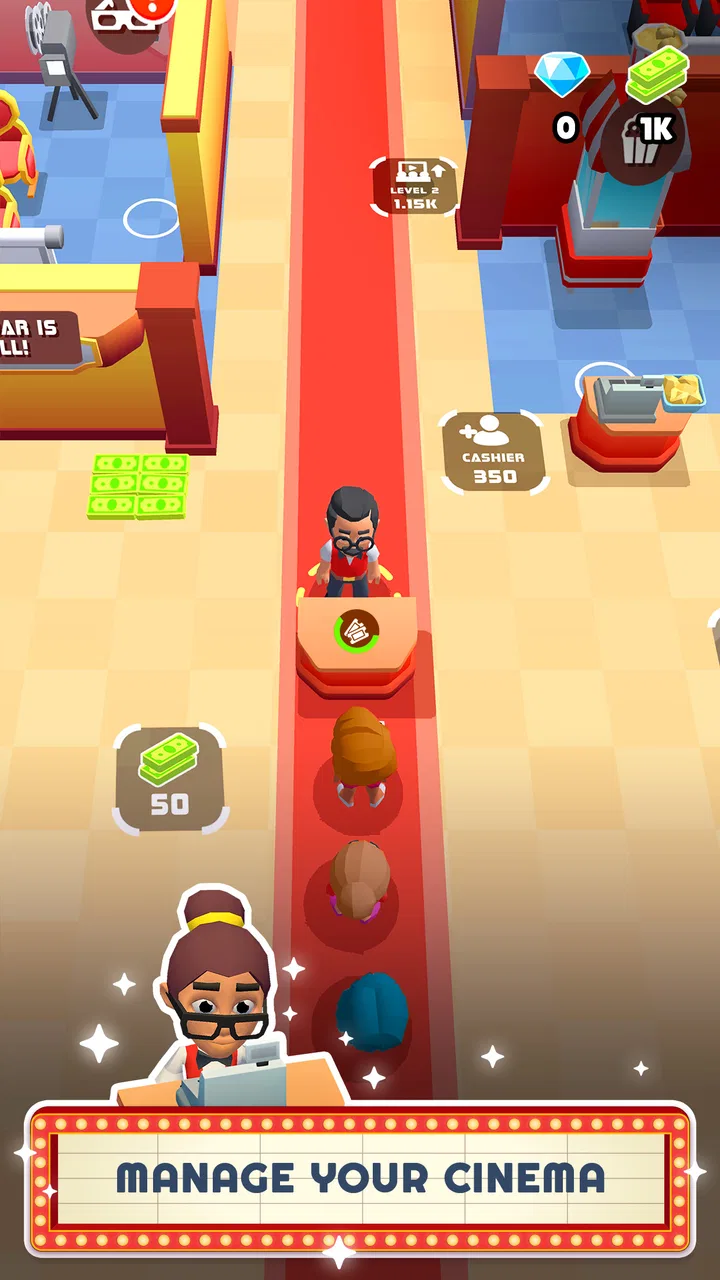
I spent time with My Cinema World as a casual arcade management game, and my first impression was clear: it is built for short, repeatable sessions rather than long, demanding play. The central idea is simple enough to understand immediately. You grow a small cinema business, improve its operation, and gradually turn a modest venue into a more productive entertainment empire. That familiar idle structure makes the game easy to pick up, but the cinema setting gives the routine a pleasant sense of progression.
What makes it appealing is the combination of light management and arcade-style accessibility. I never felt that I needed to study a complicated rulebook before making progress. Instead, I could open the game, check what needed attention, make a few upgrades, and leave with the feeling that the venue had moved forward. That makes it a natural fit for players who enjoy watching a business develop without wanting a full simulation experience.
At the same time, this is not a realistic cinema-management simulator. The focus is on momentum, upgrades, and the satisfaction of making a small operation more successful. If you want detailed film scheduling, staff management, financial forecasting, or a deep economic model, this is probably too light. If you want a friendly mobile game that turns a cinema theme into a relaxed progression loop, it is much easier to recommend.
You May Also Like

 Blood Strike: 2.5 Anniversary
Blood Strike’s Loadouts Turn Every Drop Into a Tactical Gamble
A close look at Blood Strike’s custom loadouts: how fast access to signature weapons reshapes its battle royale rhythm, rewards preparation, and narrows the gap between fights.

 Pandora - Music & Podcasts
Pandora’s Music Is Easy to Start, but Harder to Recover
Pandora’s strength is its low-effort path from a seed to a station. Its weak spot is how much confidence it asks you to place in connection, setup, and quiet recovery.

 8 Ball Pool
 Is Built on Rivalries, Rematches, and Routine
A close look at the rivalries, rematches, shared routines, and unanswered safety questions that turn a quick pool match into a persistent mobile community.

 Samsung Music
’s Quiet Strength Is Playing What You Already Own
Its reach comes less from spectacle than from dependable access to a personal library. That simplicity is both the app’s strongest retention engine and its ceiling.

 AccuWeather: Weather Radar
AccuWeather Review: A Quick, Clear Forecast for Everyday Decisions
For everyday plans, the best forecast is the one you can understand quickly. AccuWeather makes rain timing, radar, and local conditions easy to act on, with a few trade-offs.

 Hill Climb Racing
Why Hill Climb Racing Still Turns Crashes Into One More Run
A tiny car, a bumpy hill and one more upgrade: Hill Climb Racing keeps resurfacing because its simple chaos makes every near-miss feel personal.
More From Our News Desk



How the cinema-building loop feels in everyday play
The most enjoyable part of the game is the steady rhythm between checking the venue and deciding what deserves attention next. A typical session can be brief: I return to see how the business is doing, collect or use the available progress, improve an area, and then decide whether to keep playing or come back later. That structure works well on a phone because it does not demand a large uninterrupted block of time.
I can imagine playing it during a commute, while waiting for an appointment, or in the evening when I want something more interactive than scrolling but less intense than a competitive arcade game. The cinema theme also gives the progress a more recognizable shape than an abstract idle counter. Expanding a venue feels more satisfying when I can connect the improvement to the idea of serving more moviegoers and building a larger entertainment business.
The important thing is to treat each visit as a small management decision, not as a race. The game is at its best when I allow the operation to grow gradually. Trying to force constant progress can make the routine feel repetitive, while accepting the idle pace makes each return visit feel more rewarding. That is a useful mindset for anyone coming from faster arcade games and expecting nonstop action.
There is also a practical benefit to the simple presentation. Because the main objective is easy to grasp, I can return after a break without needing to reconstruct a complicated plan. That lowers the mental cost of playing. For a casual game, this matters more than having a huge number of systems. A title that is easy to resume often gets more use than one that is deeper but demanding.
What I would prioritize during a session
My first tip is to avoid spending every available resource immediately just because an upgrade is visible. I found the game more comfortable when I looked at the broader direction of the cinema rather than treating each improvement as an isolated purchase. A small upgrade that helps the whole operation can be more useful than a tempting improvement that only feels impressive in the moment.
My second tip is to use the game in cycles. I would make a few sensible improvements, close it, and return later instead of repeatedly checking for tiny changes. This approach suits the idle design and prevents the experience from turning into a chore. It is also a good way to understand whether the game fits your habits: if you enjoy gradual returns, the structure feels natural; if you need constant activity, it may feel slow.
A third useful approach is to think of progression as a choice between immediate comfort and longer-term growth. Spending to make the current cinema feel better can be satisfying, but saving for a more meaningful step may produce a stronger sense of advancement. The game does not need to become a spreadsheet for this decision to matter. Even a casual player benefits from pausing before every purchase.
Where the arcade category helps and where it limits the game
Calling this an arcade game sets a useful expectation. The experience is approachable, visually focused, and designed around quick feedback. I do not need the patience required by a traditional business simulator, and I am not asked to manage a complicated chain of interdependent systems. That makes it friendlier for younger players and for adults who want a low-pressure distraction.
The trade-off is depth. Compared with a dedicated management game, the cinema business here is more of a playful framework than a detailed model of the industry. The theme provides context for progression, but it does not turn the game into a professional planning tool. Players who enjoy analyzing staffing, pricing, schedules, and customer behavior may eventually want something more involved.
Compared with ordinary idle games, the cinema setting gives the routine a stronger identity. Many idle games can feel interchangeable because the numbers rise without a memorable place attached to them. Here, the idea of developing a cinema gives the progress an imaginative anchor. That does not remove the repetition inherent in the genre, but it makes the repetition easier to follow and more pleasant for me.
Compared with fast arcade alternatives, the game is calmer. There is less emphasis on reflexes and more on returning to an evolving business. I would choose it over a twitch-based title when I want to feel productive without being tested. I would choose the faster alternative when I want immediate challenge, precise controls, or a clear win-or-lose moment.
What the current version says about the experience
The current version is 1.5.3.8, and the game was released on March 23, 2024. Those details place the review in a specific stage of the product rather than treating it as an unfinished concept. In my experience, the title already presents a coherent loop: build the cinema, improve its performance, and return to continue the expansion.
That version information is worth paying attention to when deciding whether to install. Mobile games can change substantially over time, so the version number is a useful marker for anyone comparing impressions from different periods. I would judge the present experience on its accessible idle-management foundation, while treating future changes as possibilities rather than promises.
The game comes from CrazyLabs LTD, a developer familiar with making approachable mobile experiences. That background is visible in the straightforward design. The game does not feel as though it is trying to turn a simple premise into an intimidating management exercise. Instead, it aims for quick understanding and a broad audience.
That approach also explains why the game can be enjoyable within minutes but may not satisfy players looking for a long-term strategic challenge. The current state feels more polished around accessibility and repeat play than around simulation complexity. For me, that is not automatically a weakness; it simply defines the audience more clearly.
How the progression affects returning players
Existing players will likely appreciate the fact that the central routine remains easy to resume. If I have only a few minutes, I can still make meaningful progress without committing to a full play session. That is one of the strongest qualities of an idle cinema game: it can fit around real life instead of asking real life to fit around it.
However, returning players should watch for the point at which the familiar routine begins to feel too predictable. The early sense of building something new is naturally stronger than the later repetition. Once the basic pattern becomes familiar, enjoyment depends more on personal attachment to gradual improvement. I continued to find value in the small decisions, but players who need frequent surprises may lose interest sooner.
The game’s free price makes trying that progression low-risk. I can install it without making an upfront payment and decide from actual play whether the pace works for me. The important qualification is that free access does not mean the entire experience is free of commercial pressure. In-app purchases range from $1.99 to $99.99 per item, so I would approach optional spending carefully and set a personal limit before buying anything.
That price range is especially relevant for families. The Teen content rating means parents should not assume that the game is aimed at very young children simply because its management concept is light. I would review the purchase settings on the device before handing it to a child, and I would explain that optional purchases can affect how quickly someone progresses. That small preparation prevents an otherwise casual game from becoming an unpleasant surprise.
The game supports devices running Android 7.0 or later. For many Android users, that makes it broadly accessible, although the actual comfort of play will still depend on the phone or tablet. I would keep enough free storage available, install it from the official app marketplace, and close other demanding apps if the device is older. Those are practical steps for getting a smoother session from any mobile game with an evolving visual scene.
Where the design still leaves room for improvement
The biggest limitation is the familiar one for idle games: the player can eventually feel more like a supervisor than an active manager. Watching progress accumulate is satisfying at first, but it does not provide the same involvement as making frequent, meaningful choices. If the game’s pacing does not offer enough decisions between returns, some players may regard the cinema as a background process rather than a place they actively run.
Another limitation is that the theme can create expectations the gameplay may not fully meet. A cinema naturally suggests choices about films, audiences, showtimes, concessions, seating, and staff. Players who arrive hoping to control every part of that business should understand that this is an arcade interpretation, not a comprehensive theater simulator. I enjoyed the theme as a setting for growth, but I would not buy into it expecting operational realism.
Optional purchases are another point to consider. A free game can be a good way to sample the loop, yet the presence of purchases from $1.99 to $99.99 means the experience deserves the same spending discipline as other free-to-play titles. I would never treat a faster upgrade as necessary simply because it is offered. The better test is whether the game remains enjoyable when played at its normal pace.
The content rating of Teen may also make the game less suitable for a child than its colorful business premise initially suggests. That does not tell me how every family will experience it, but it is enough reason to check the rating and purchase controls before sharing access. For adults, the rating is a reminder to approach it as a general-audience mobile game rather than a preschool product.
Finally, the game may not be the right choice for someone who wants a complete offline hobby, a story-driven campaign, or a competitive arcade challenge. Its appeal comes from incremental development and repeated visits. If those qualities sound relaxing, the gaps are manageable. If they sound like a lack of content, another genre will serve you better.
Who should install it and who should skip it
I would recommend the game to players who enjoy idle progression but want a more concrete setting than a generic factory or abstract number generator. It is also a good match for people who like the idea of managing a small business without wanting to calculate every expense. The cinema theme adds personality, while the arcade structure keeps the learning curve gentle.
It suits a player who checks a phone several times a day and enjoys making a few decisions each time. The realistic everyday scenario is simple: I might open it during a coffee break, improve the venue, return after work to see how the business has advanced, and make one or two more choices before putting the phone away. That pattern feels more natural here than trying to play continuously for hours.
I would be more cautious recommending it to a player who dislikes waiting, repeated upgrade screens, or optional purchase prompts. I would also steer away anyone looking for a detailed cinema simulation. A more traditional management game would be better for someone who wants to compare costs, balance staff, plan schedules, and respond to complex customer behavior.
Reflex-focused arcade fans should also know what they are choosing. This is not the game I would open when I want rapid reactions or increasingly difficult action. Its challenge is mostly about deciding how to develop the business and how patiently to follow its pace. That can be calming, but it will not replace a high-energy arcade session.
What I would watch as the game continues
For future development, I would pay attention to whether new updates deepen the cinema theme without making the game harder to understand. More meaningful choices would be valuable if they give returning players fresh reasons to plan, rather than simply adding more things to tap. The best direction would preserve the quick-session convenience while giving experienced players more control over how their cinema grows.
I would also watch how the balance between free progression and optional spending feels over time. The free price is a strong invitation to try the game, but long-term trust depends on whether players can enjoy the central loop without feeling pushed toward purchases. That is particularly important for a title that encourages frequent returns.
Existing users should keep an eye on the version number when reading older advice. The current release, 1.5.3.8, is the most relevant reference point for present play, while older impressions may describe a different balance or presentation. I would separate confirmed changes from speculation and judge each update by what it actually adds to the daily cinema routine.
In the end, I see My Cinema World as a pleasant, accessible arcade management game with a clear identity and a sensible place in the idle genre. Its strongest feature is not complexity; it is the ease with which I can return, make a few choices, and feel that my cinema is moving forward. Its weakest point is the same simplicity, because players who need deep systems or constant action may find the loop too limited.
With a 4.6 average from around 87 thousand ratings and over 5 million installs, it has clearly found a sizeable audience. I would still treat those figures as a sign of broad appeal, not a guarantee that every player will enjoy the pace. For me, the deciding question is whether you like gradual progress. If you do, the free download is an easy experiment. If you want a serious business simulator or a demanding arcade challenge, I would choose another game instead.
My recommendation: try it when you want a relaxed cinema-building routine that fits into spare moments, but keep purchases optional and your expectations focused on casual progression. That is where the game feels most comfortable, and where its small cinema world has the best chance of becoming a satisfying part of your mobile gaming rotation.
FAQs for My Cinema World
01What is My Cinema World and what features does it offer?
My Cinema World is an immersive app designed for film enthusiasts. It offers features such as personalized movie recommendations, detailed film reviews, virtual cinema experiences, and community forums for discussions. Users can also create watchlists and participate in trivia games to test their cinema knowledge. The app provides a comprehensive platform for all things related to movies.
02Is My Cinema World available on both Android and iOS platforms?
Yes, My Cinema World is available for download on both Android and iOS platforms. It ensures a seamless experience across different devices, allowing users to enjoy its features whether they are using a smartphone or tablet. You can find the app on the Google Play Store for Android devices and the Apple App Store for iOS devices.
03Does My Cinema World require a subscription or is it free to use?
My Cinema World offers a free version with basic features suitable for casual users. However, there is also a premium subscription option that provides additional features, such as ad-free browsing, early access to new content, and exclusive virtual screenings. This allows users to choose the experience that best fits their needs and budget.
04How user-friendly is the interface of My Cinema World for new users?
The interface of My Cinema World is designed to be intuitive and user-friendly. New users will find easy navigation through clearly labeled tabs and menus. The app also includes a tutorial for first-time users, ensuring they can quickly learn how to access all features and make the most out of the app without any confusion.
05What kind of community interactions does My Cinema World facilitate?
My Cinema World fosters a vibrant community where users can interact through forums and chatrooms dedicated to various genres and topics. Users can participate in discussions, share reviews, and even host virtual movie nights. This interactive feature encourages engagement and allows users to connect with fellow movie enthusiasts from around the world.
Pros
- Intuitive and user-friendly interface.
- Extensive library of movies and shows.
- High-quality streaming options available.
- Customizable watchlists and reminders.
- Regular updates with new content.
Cons
- Requires a stable internet connection.
- Subscription needed for premium features.
- Occasional buffering on lower bandwidth.
- Limited offline viewing options.
- Ads in the free version can be intrusive.

My Cinema World
Gallery